
Cloud vs. Local Digital Display Management | Which is Best for Business?
Introduction
Electronic screens have become a necessity in contemporary communication plans. In retail stores and restaurants, airports and corporate offices, business entities use digital signage to interact with their customers, provide updates, and market their brand.
It is not just having a display screen. The question is: what do you do with the material displayed on those screens?
In this case, there are usually two choices to the businesses:
1. Cloud-Based Management
2. Local (On-Premise) Management
Each possesses its own advantages and disadvantages. The selection of the correct system is based on the size of your business, budget, and requirements. Let's break them down.
What is Cloud-Based Digital Display Management?
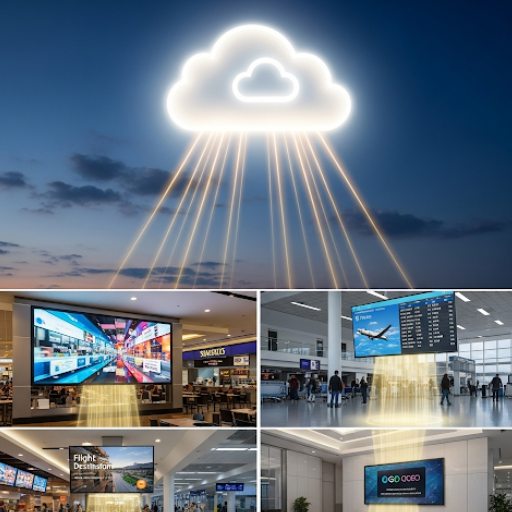
Pall- grounded operation, means you can ever( via an internet connection) manage your digital displays. A pall garçon stores the content, schedules and updates and pushes them to defenses in real time.
Advantages
- Remote Access: Update defenses from anywhere, anytime.
- Centralized Control: Control several locales with a single dashboard.
- Scalability: Add further displays fluently without the need to dodge heavy structure.
- Robotization: Schedule juggernauts and automate updates.
- Real- Time Updates: Push exigency cautions or time-sensitive elevations incontinently.
Disadvantages
- Internet Dependence: Requires stable connectivity.
- Subscription Cost: Recreating SaaS charges can be more precious with long term operation.
- Data Security: Data that's sensitive should be translated.
What is Local Digital Display Management?
Local management (on-premise) implies that the content is stored on a server or media player on the location. The scheduling and updates are manual or by the use of LAN (Local Area Network).
Advantages
- Offline Capability: Works even without internet.
- One-Time Cost: No monthly subscription fees.
- Data Security: The information is stored locally, so there is less risk of cloud-related problems.
- Customization: More flexibility to companies that have in-house IT.
Disadvantages
- Restricted Remote access: Updates cannot be made unless you are physically present or attached to the same network.
- Maintenance Costs: Hardware, servers, and IT staff add expenses.
- Scalability Problems: Very costly to add more displays to the infrastructure.
- Delay in Updates: Real time communication is hard across locations.

Cloud vs. Local: A Feature-by-Feature Comparison
| Feature | Cloud-Based Management | Local Management |
|---|---|---|
| Access | Remote, global access | Local network or on-site only |
| Scalability | Easily scalable across locations | Limited scalability, hardware-dependent |
| Cost | Monthly/annual subscription fees | One-time setup, but higher maintenance |
| Updates | Real-time, automated scheduling | Manual or LAN-based scheduling |
| Security | Dependent on provider’s cloud security | Local storage, internal IT security |
| Internet Dependency | Requires internet connection | Works offline |
| Best For | Multi-location businesses, franchises | Small businesses with one/few displays |
Which One Should You Choose?
Select pall- Grounded operation when
- You operate outlets or votes.
- You ask to have centralization anywhere.
- You bear real time information( deals offers, exigency cautions, menus).
- You're seeking an expandable and adaptable result.
Choose Original operation if
- Your business is a small bone with 1- 2 displays.
- Your network is n't dependable.
- You like one- time purchase to subscriptions.
- You would like to have complete data storehouse and security.
Future Trends: Why Cloud is Gaining Popularity
As IoT, AI-based analytics and real-time marketing gain momentum, companies are moving towards cloud computing. They can be integrated with real-time data feeds (weather, social media, stock prices), and can also be personalized at scale.
Nevertheless, local systems will not disappear. In the case of industries that have a high level of security measures (such as government, defense, and banking), on-premise management will still be applicable.
Final Thoughts
This decision is cloud vs. local digital display management and it hinges on your business model, budget and long-term objectives.
- Scalability, flexibility and centralized control are better with cloud.
- Local works well for smaller setups or industries with strict offline requirements.
When you assess your requirements and future aspirations, you are able to choose the appropriate remedy that will maintain your displays interesting, dependable and effective.